
What this document is
The enterprise standard for measuring what a programme actually costs to operate and sustain — direct cost, allocated shared services, recognised capital and risk, unbudgeted capacity demand, and the reserves required to keep running past the current grant.
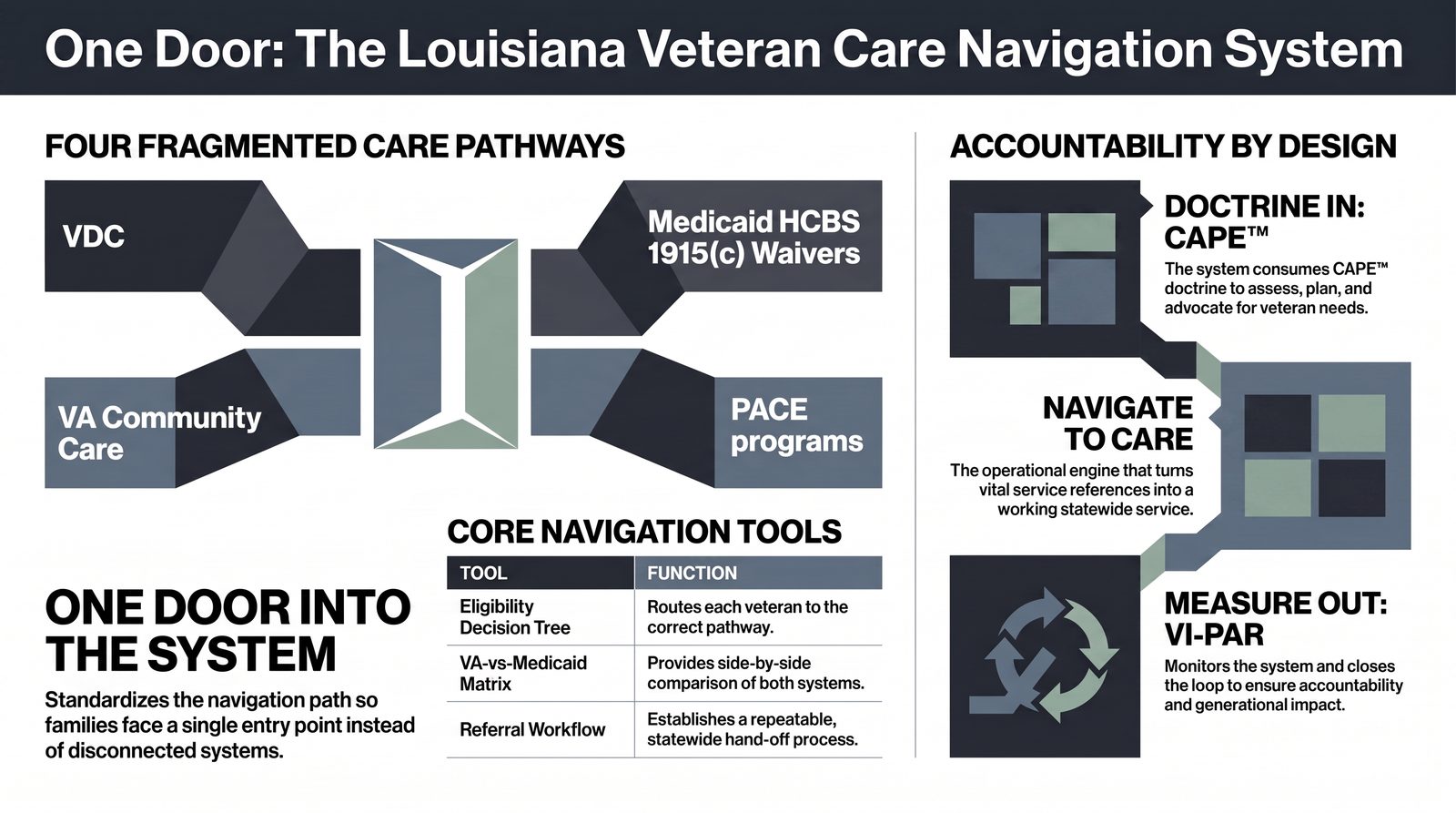
The problem it solves: veterans and caregivers face The problem it solves: a programme can look fully funded while quietly consuming executive time, finance, technology, compliance and fundraising capacity that appears nowhere in its budget. EFCPAS™ makes that consumption visible before it becomes structural.. The framework standardizes the path so families face one door, not many.
It is designed to become a It supplies the cost and recovery gate that sits between EFIRS™ feasibility and any funding, pricing, scaling or continuation decision, and feeds standardised cost metrics into VI-PAR™ and BIBS™. and a repeatable reference for the navigation team, with VI-PAR™ monitoring closing the loop.
A budget is not a cost
A program budget shows what the program spends. It does not show what the program consumes.
A grant covers the coordinator, the travel and the supplies, so the program looks fully funded. Meanwhile it draws on executive attention, finance, technology, facilities, compliance, data and fundraising — none of which appear anywhere in its budget.
That gap has a number. A program with an apparent $180,000 budget can consume closer to $240,000 once shared services and unbudgeted capacity are counted. The organization absorbs the difference quietly, and nobody chose to.
EFCPAS™ exists so the Board can see that difference before it becomes a habit.
Three lenses, never one number
The most common mistake in nonprofit costing is producing a single number and asking it to do three different jobs. EFCPAS™ separates them permanently.
Recorded Financial Cost is what the accounting system holds: direct expenses, allocated shared costs, and recognized capital and risk cost. This is the auditor’s number.
Economic Sustainability Cost adds validated capacity demand and the reserves required to keep operating past the current grant. This is the leadership and pricing number.
Funder-Recoverable Cost is the portion a specific grant or contract will actually pay. This is the development number.
An opportunity cost is real management information. It is not an accounting expense and it is not automatically grant-allowable. Collapsing these three is how a program looks funded while consuming the enterprise.
Five layers of a real program cost
Direct service delivery — the people, travel, supplies and contracts identifiable with the program.
Shared enterprise services — executive leadership, finance, HR, technology, facilities, insurance, compliance, communications and development, allocated by a documented driver rather than a guess.
Recognized capital and risk — depreciation or use cost, insurance, legal, audit and compliance properly attributable to the program.
Capacity demand — the supervision, coordination, reporting, partner management and evaluation the program consumes but never budgets. Management lens only, and zero if already counted elsewhere.
Sustainability requirement — replacement reserves, working capital and technology refresh. A planning number, not an accounting entry.
The four ratios a Board can act on
Full Cost Recovery Ratio — committed revenue divided by economic sustainability cost. At or above 100 percent the program pays for itself. Below 75 percent it is a sustainability exposure.
Economic Subsidy Rate — the share of cost the enterprise absorbs. A subsidy is legitimate when it is chosen. It is a governance failure when it is invisible.
Capacity Load — unbudgeted capacity as a share of financial full cost. High load means the program is running on borrowed attention.
Unit Full Cost — economic cost divided by service units. This is the only defensible figure to put in a grant budget, a sponsorship ask or a contract price.
A program with no populated cost base reports as NOT COSTED. It does not report as green.
What EFCPAS™ is not
It is not an accounting standard. It does not replace GAAP, tax reporting, award terms or professional advice. Where a funding agreement is stricter, the agreement controls.
It does not merge the entities. LCDC and EEC keep separate books, separate accounts and separate contracts. EFCPAS™ models the portfolio; it does not dissolve the legal boundary.
It does not create a right to reimbursement. Internal economic cost is not the same as an allowable charge. For federal awards the controlling terms and 2 CFR Part 200 decide what may be recovered.
Where it sits in the stack
EFIRS™ determines feasibility. EFCPAS™ determines cost and recovery. Together they form the gate: an initiative may be strategically sound and still financially unsustainable, and a fully recoverable program may still fail on mission or readiness.
Approved cost structures flow into VE-OSMF™ for operating plans, into VI-PAR™ as standardized cost and recovery metrics, and into BIBS™ as the Board sustainability view.
The chain runs: concept → EFIRS™ feasibility → EFCPAS™ full cost → funding, pricing and subsidy decision → authorization → execution → performance → Board oversight → annual portfolio review.
The The financial control layer for the whole library for — the most build-ready operational system in the library. It consumes CAPE™ and the Vital Services reference and turns them into a working statewide service.
This anchor is a draft until leadership shapes it. As you read:
- Which programmes should be costed first under this standard?
- Where is the enterprise currently absorbing cost nobody approved?
- What subsidy level is the Board willing to authorise, and for how long?